Boat and RV Storage Financing: A Guide for Buyers and Developers
Drive through any Sun Belt suburb on a Saturday and you’ll see the demand firsthand: boats and RVs parked in driveways, squeezed beside houses, and — increasingly — ticketed by homeowners associations that prohibit them. Somewhere between the HOA fine and the dream of a bigger garage sits one of the most interesting niches in the storage business: dedicated boat and RV storage.
Boat and RV storage rides the same wave as traditional self-storage — people own more than their homes can hold — but the economics, the sites, and the financing all have their own character. The product is simpler to build, the tenants are more seasonal, and lenders underwrite it on different assumptions.
This guide covers the product types, the demand drivers, what lenders want to see, how SBA programs treat boat and RV storage, and how to structure the financing whether you’re buying an existing facility or developing from scratch.
1. The Three Product Types: Uncovered, Covered, and Enclosed
Boat and RV storage comes in three tiers, and the tier determines everything about the investment — build cost, achievable rent, tenant quality, and how a lender values the asset.
Uncovered (open) storage is the simplest product: a secured, usually paved or well-graded gravel lot where customers park boats and RVs in striped spaces. Build costs are minimal — grading, surfacing, fencing, gating, lighting, and cameras. Rents are the lowest of the three tiers, but so is the capital at risk, and the yield on invested capital can be excellent precisely because there’s so little capital invested.
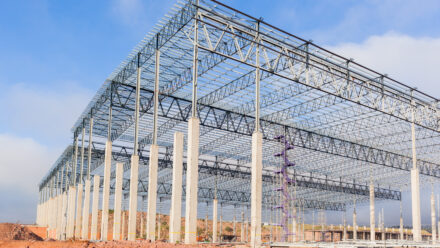
Covered storage adds a canopy — typically a metal roof structure on columns, open on the sides — that protects vehicles from sun, rain, and hail. This is the sweet spot for many markets: a meaningful step up in rent over open parking, a moderate step up in build cost, and strong appeal to owners of higher-value RVs and boats who want protection without paying for four walls. Canopy structures are relatively quick to permit and erect, which keeps development timelines short.
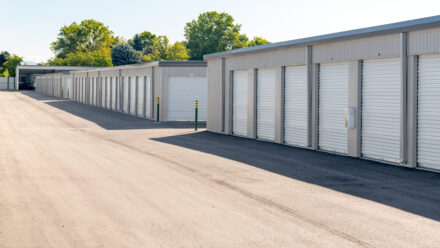
Enclosed storage is the premium tier: fully enclosed units with individual doors, sized for large vehicles — typically 12 to 14 feet wide, 14 to 16 feet tall at the door, and 30 to 50 feet deep. These are essentially oversized garages, and they command the highest rents in the segment. Build costs are the highest of the three tiers — real buildings with real systems — but the income per square foot and the collateral value are correspondingly stronger.
Most successful facilities mix the tiers — open parking for the price-sensitive customer, canopy-covered spaces as the core product, and enclosed units at premium rents — serving the full demand curve on one parcel and giving lenders a diversified income stream rather than a single-product bet.
2. Demand Drivers: Seasonality, Demographics, and Regulations
Understanding why customers rent boat and RV storage — and when — is essential, because lenders will ask you to explain the demand story with more rigor than traditional storage requires.
HOA and municipal restrictions are the single most reliable demand driver. A large and growing share of suburban homeowners live under covenants or ordinances that prohibit parking boats, RVs, and trailers at home — or restrict them so tightly (behind a fence, under a carport, out of sight) that compliance is impractical. Every new deed-restricted subdivision is effectively a pipeline of future storage customers. When you’re evaluating a market, the prevalence of HOAs isn’t a footnote; it’s a primary demand indicator.
Demographics. Boat and RV ownership skews toward households with disposable income and outdoor-recreation lifestyles — and toward retirees, particularly in the Sun Belt. Markets with growing retiree populations and recreation access consistently outperform, and proximity to where people actually use their boats and RVs — lakes, coastlines, snowbird corridors — matters enormously. A facility twenty minutes from the boat ramp leases; a facility two hours away doesn’t.
Seasonality. Here’s the characteristic that most distinguishes this niche from traditional self-storage: demand and occupancy breathe with the seasons. In northern markets, boats come out of storage in spring and go back in fall; in snowbird markets, RV occupancy peaks in winter. Year-round occupancy runs lower than a comparable traditional facility, and month-to-month tenant turnover is higher — customers store for the season, not for years. This doesn’t make the business bad; it makes it seasonal, and the financing has to be structured around annualized, stabilized income rather than peak-season snapshots. Lenders know this, and they’ll underwrite accordingly — as covered in the sections below.
3. Site Requirements That Differ From Traditional Storage
A boat and RV facility is not a traditional storage facility with bigger units. The site requirements diverge in ways that affect both development cost and financing.
- More land. Boats and RVs are big, and maneuvering them requires big drive aisles — far wider than the aisles in a traditional facility. A boat and RV operation typically needs a larger parcel than a traditional facility of comparable rentable square footage, with much of the acreage devoted to circulation rather than rentable space. When you’re buying land, underwrite the usable layout, not just the gross acreage.
- Ingress, egress, and turning radii. Customers arrive towing large rigs. The entrance needs to accommodate large turning movements from the road, the internal circulation needs to let those rigs reach their spaces and turn around, and the exit can’t require a three-point turn with a boat trailer. A site that works beautifully for traditional storage can be functionally unusable for RVs — evaluate circulation with the actual vehicles in mind.
- Visibility matters less; access matters more. Traditional storage lives on drive-by visibility. Boat and RV customers are destination users — they find the facility online, drive there deliberately, and care far more about easy highway access and simple ingress than about monument signage on a retail arterial. This opens up cheaper, less visible parcels that would never work for traditional storage — a genuine cost advantage if you site it well.
- Surfacing and drainage. Open and canopy storage means large impervious areas. Paving, grading, and stormwater detention for a multi-acre vehicle lot is a real site-work budget — and in some jurisdictions, the stormwater requirements for a big paved lot are the binding constraint on the site plan. Get civil engineering input early.
- Amenities that drive rents. Electrical hookups at spaces, water fill stations, dump stations, wash bays, air compressor stations, and Wi-Fi-enabled security with cameras customers can check remotely — these are the amenities that separate premium facilities from parking lots, and they support the rent spreads between tiers. They’re also relatively cheap to install during development and expensive to retrofit later.
- Security. You’re storing vehicles worth substantial sums. Gated access, perimeter fencing, lighting, cameras, and ideally on-site or remote-monitored management aren’t optional extras — they’re the product. Lenders and insurers both evaluate security infrastructure when they look at the asset.
4. How Lenders View Boat and RV Storage vs. Traditional Self-Storage
Lenders will finance boat and RV storage, but they underwrite it more conservatively than traditional self-storage — and structuring your deal to survive those adjustments is the key to getting financed.
Seasonality gets normalized. The underwriter won’t size your loan on peak-season occupancy — they’ll use annualized, stabilized income: trailing twelve-month performance for an acquisition, or a pro forma that realistically models the seasonal curve for a development. If your projections show peak-season occupancy in July and assume it holds through January, expect the lender to rebuild the income statement around the annual average.
Leverage runs lower. Compared with traditional self-storage, lenders typically offer lower loan-to-value ratios on boat and RV facilities — the income is more cyclical, tenant turnover is higher, and the collateral (particularly open parking) has less alternative-use value than a climate-controlled building. Where a traditional facility might see relatively high leverage from a conventional lender, a boat and RV deal should be structured with more equity. The exact numbers vary by lender and by tier mix — enclosed units underwrite closer to traditional storage than open parking does — but plan your capital stack conservatively and you won’t be surprised.
Coverage standards tighten. The standard debt service coverage benchmark still applies, but lenders scrutinize the income side harder: is the NOI based on in-place, annualized rents, or on pro forma absorption that assumes the seasonal peak lasts all year? Stress-testing matters more here — the lender wants to see the loan covered in the off-season, not just on the blended average.
Tier mix affects collateral value. An appraiser valuing a boat and RV facility leans on the income approach, same as traditional storage — but the income is tiered, and the tiers have different risk profiles. Enclosed units produce the most defensible income; open parking produces the most volatile. A facility heavily weighted toward enclosed and covered storage appraises and finances more like traditional self-storage. A pure open-parking lot is closer to a land play with income — financeable, but on different terms. For how income-based valuations work in this asset class generally, see How to Value a Self Storage Facility.
5. SBA Eligibility for Boat and RV Storage
Boat and RV storage businesses are eligible for SBA financing under the same framework as traditional self-storage — with the same key conditions. The SBA finances operating businesses, not passive investments, so the facility needs to be actively operated: management, leasing, maintenance, customer service, security oversight. A fenced lot with no operational presence looks passive; a professionally managed facility with staff, systems, and services looks like a business. How you operate the property is part of the eligibility conversation with your lender.
The program mechanics carry over directly. Under SBA 7(a): a strong maximum loan size, a modest minimum borrower injection, variable rates typically tied to Prime, long terms for real estate, and the ability to finance acquisition, construction, and working capital in one loan. Under SBA 504: the bank/CDC/borrower structure with a long-term fixed rate on the debenture portion — but because boat and RV storage is special-purpose property like traditional self-storage, the borrower’s minimum injection rises above the standard amount (higher still if the business is less than two years old), and the operating business must occupy the majority of an existing facility or a set share of new construction.
Two practical notes. First, start the eligibility conversation early. SBA lenders vary in their comfort with specialty storage — some have done dozens of boat and RV deals, others will treat yours as the first. A lender with direct experience in the niche will move faster and structure better than one learning on your application. Second, the size standards apply — the SBA’s caps on tangible net worth and average net income cover the vast majority of independent operators in this space. Full program comparison: SBA Loans for Self-Storage Facilities.
6. Financing Structures for Buyers and Developers
Whether you’re buying an existing facility or building one, the financing follows the same logic as traditional storage — adjusted for the niche’s risk profile.
Acquiring an existing facility. This is the cleanest entry point: trailing twelve-month financials (seasonality visible and documented), an existing customer base, and in-place infrastructure. SBA 7(a) is the workhorse — a modest borrower injection with working capital included — and conventional bank loans compete aggressively for stabilized facilities with strong annualized coverage. Underwrite the acquisition on the trailing annual average, not the best quarter, and make sure your equity cushion reflects the lender’s lower leverage appetite for the asset class.
Developing from scratch. Ground-up boat and RV development is cheaper and faster than traditional storage construction — canopies and paving go up quickly — which means smaller loan amounts and shorter construction periods. Less capital at risk, faster path to income. The development loan still needs the standard package: entitled land, contractor bids, a lease-up pro forma with honest seasonal modeling, and your equity injection.
Adding boat and RV to an existing traditional facility. This is one of the smartest expansion plays in the industry: excess or underused land at your existing facility — the back acreage, the awkward parcel next door — converted to covered or open RV/boat storage. The customer acquisition is nearly free (your existing brand and location), the incremental operating cost is low, and the income diversifies your revenue. Financing typically runs through expansion structures — SBA 7(a), conventional construction, or a cash-out refinance of the existing facility that funds the addition. Details: Self-Storage Expansion Financing.
And for the baseline requirements every lender applies, Self Storage Financing Requirements covers the full checklist.
7. Frequently Asked Questions
Is boat and RV storage eligible for SBA loans?
Yes — under the same framework as traditional self-storage. The business must be actively operated, not a passive investment, and meet the standard SBA tests: size standards, the standard borrower injection under 7(a) (higher under 504 for special-purpose property), and debt service coverage on the lender’s numbers. Discuss the operating structure with your lender early.
Which tier finances best — uncovered, covered, or enclosed?
Enclosed and covered storage finance more like traditional self-storage: higher, more defensible income per square foot and stronger collateral value. Open parking is financeable but typically at lower leverage, since the income is more seasonal and the collateral is essentially improved land. A mixed-tier facility gives lenders the best of both — diversified income with a solid core of higher-tier rents.
How much land does a boat and RV facility need?
More than you’d need for a traditional facility of comparable revenue — wide drive aisles and large turning radii consume significant acreage. The exact requirement depends on your tier mix and layout, but plan on a larger parcel than traditional storage and verify the usable layout (not just gross acreage) with a site plan before you buy. Underwriting the land cost against the rentable spaces it actually yields is the key math.
Do lenders worry about the seasonality?
Yes — it’s the first adjustment they make. Expect the underwriter to size the loan on annualized, stabilized income rather than peak-season performance and to stress-test coverage through the off-season. Bring the seasonal data yourself, modeled honestly: lenders reward borrowers who understand their own cyclicality.
Final Thoughts
Boat and RV storage is one of the most accessible on-ramps in the storage business: lower build costs, faster development timelines, genuine demand driven by HOAs and outdoor lifestyles, and SBA-eligible financing that works when the deal is structured around honest annualized income. The operators who succeed respect what makes the niche different — enough land for real truck circulation, the seasons modeled instead of ignored, and data instead of optimism at the lender’s table.
At US Professional Funding, we bring more than 30 years of lending experience to financing specialty storage — acquisitions, ground-up development, and expansions of existing facilities into boat and RV. If you’re looking at a deal in this niche, we’ll help you structure it around how lenders actually underwrite it.